
Your goods passed inspection, and the quantity was confirmed. You’re almost at the finish line – except there’s one moment: the loading of the container. Wrong quantities slipped in, damaged pallets, goods thrown in loose and unsecured, a mystery weight discrepancy – none of it shows up on paper until the container is opened in your warehouse. A container loading supervision report is the check that watches that final, critical step. Here’s exactly what it contains, so let’s go through a real example.
What is a container loading supervision?
Container loading supervision (sometimes called a loading inspection or loading check) puts an independent inspector at the factory or warehouse on the day your goods are loaded. They confirm the right products and quantities go into the right container, check the container’s condition, watch how everything is stacked and secured, record the seal number, and photograph the whole process from empty to sealed. The report is the proof of what actually went into the container that sails to you.
Walking through a real report
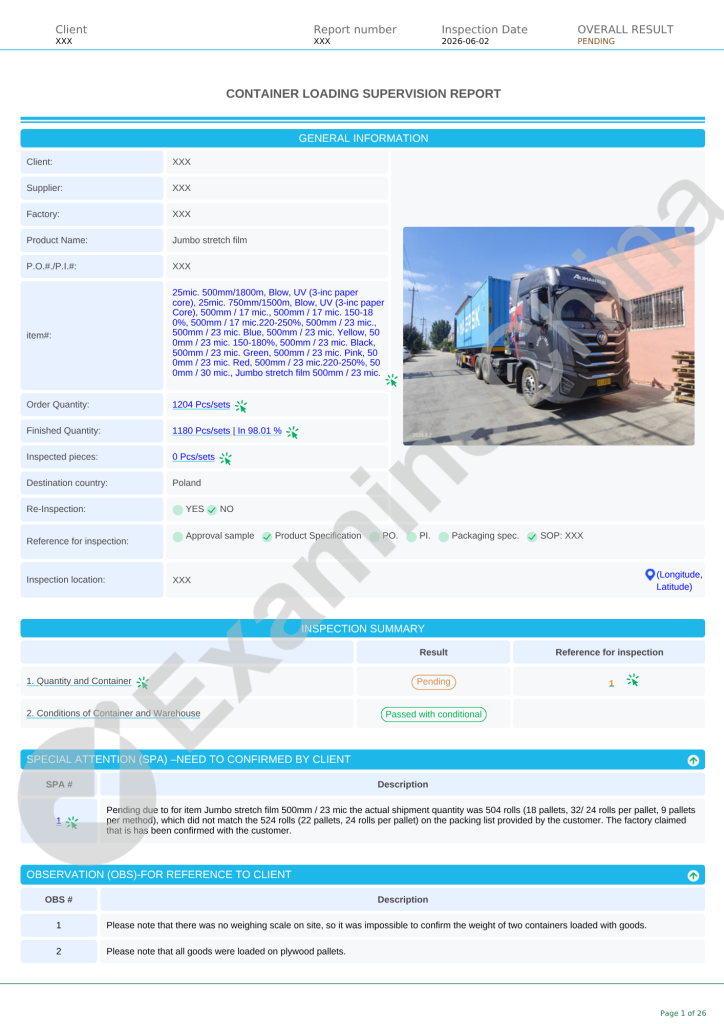
Our example is a shipment of jumbo stretch film – many variants, colors and gauges – heading to the EU across two 40HQ containers. Order quantity: 1,204 units. The final verdict on the cover: PENDING. Let’s see how it got there.
1. Quantity and container check
The inspector matches what’s loaded against your packing list and PO, container by container, item by item. In our report, this is exactly where the trouble surfaced.
The discrepancy between the packing list and reality
For one item, the actual loaded quantity was 504 rolls on 18 pallets – but the packing list said 524 rolls on 22 pallets. A 20–roll gap. The factory claimed it had been confirmed with the customer, but the inspector flagged it as a “Special Attention” item for the importer to verify. Without supervision, that gap becomes an unpleasant surprise weeks later, with no way to prove what was actually shipped.
Quick tip: it’s better to discover quantity mismatch caught at loading. The same mismatch caught at delivery is a dispute.
2. Condition of the container and warehouse
A perfect product ruined by a leaky container is still a ruined product. The inspector checks whether the container has holes, rust inside, a working door and draught seal, and whether the warehouse is clean, dry and suitable. In our example, both 40HQ containers were rated in good, hole–free condition – the kind of confirmation that matters for goods sensitive to damp.
3. How the goods were loaded and secured
This is where loading supervision ready comes in handy. The report noted that all goods were stacked on plywood pallets, but it also flagged a real problem: after loading, there was empty space at the top and rear of the containers, and the goods had not been secured in any way. Loose cargo in a moving container is how product arrives crushed or toppled. That single observation gives the importer grounds to demand proper bracing before the doors close.
4. Weight, seals and timing
The report records the loading start and finish times, the container numbers and the seal numbers – your assurance that nobody opens the container between the factory and the port. It also honestly noted a gap here: there was no weighing scale on site, so the loaded weight of the two containers couldn’t be confirmed. That transparency about what couldn’t be checked is a mark of a trustworthy report.
5. Photo trail from empty to sealed
Finally, the report documents the entire loading in sequence: the empty container, the container number, the first layer, then 1/4, 1/2, 3/4 and fully loaded, and finally the closed door with the seal and seal lock number. If anything is ever disputed, this photo trail is your evidence of exactly what left China and how.
One honest caveat worth knowing
Loading supervision confirms the right goods, right quantity, right container, properly loaded – but it is not a full product–quality inspection. Only a small number of samples are checked to confirm the model. If you also need defects, function and specification checked, that’s a separate quality inspection in China, ideally done before loading day. The two services complement each other: one guarantees quality, the other guarantees that quality actually makes it into the container.
What “PENDING” really means for the importer
The verdict wasn’t “Failed” – it was “Pending,” meaning the loading broadly went ahead but open issues remained for the client to resolve. Because of the report, the importer could challenge the 20–roll quantity gap, insist the cargo be secured, and hold documented proof of container condition and seals – all before the ship left. A two–hour supervision replaced what could have been a months–long claim.
Why the loading supervision is worth it
Loading supervision costs a fraction of a single container’s freight – and far less than a shipment that arrives short, damaged or unsecured. It’s the cheapest way to guarantee that everything you paid for, in the condition you approved, actually leaves China in your container.
If you want that final safeguard on your next shipment, we can arrange independent loading supervision and deliver a report just like the one above.
Strong loading starts long before loading day. Before you commit to a supplier, confirm they’re real and reliable with a supplier credit report. And put quantities, packing, loading and securing requirements in writing – a solid commercial contract is what turns “the packing list should match” from a hope into an obligation you can enforce.