
Like every year, 2028 in China is packed with holidays that ripple straight through production, logistics, and delivery times. For an importer, that’s not cultural trivia; it’s planning. During Spring Festival or Golden Week, factories go dark, ports slow down, and getting a reply from a supplier can take a week or more. Below you’ll find the dates of the major Chinese holidays in 2028, along with what to expect on the supply side.
⚠️ Before you plan: China’s exact days off are set each year by the State Council and usually announced in November of the year before, together with the makeup workdays (weekends that become working days). That means the official 2028 arrangement won’t appear until late 2027. The festival dates below are fixed, but the specific holiday blocks are a forecast based on current rules. Confirm them against the official notice once it’s published.
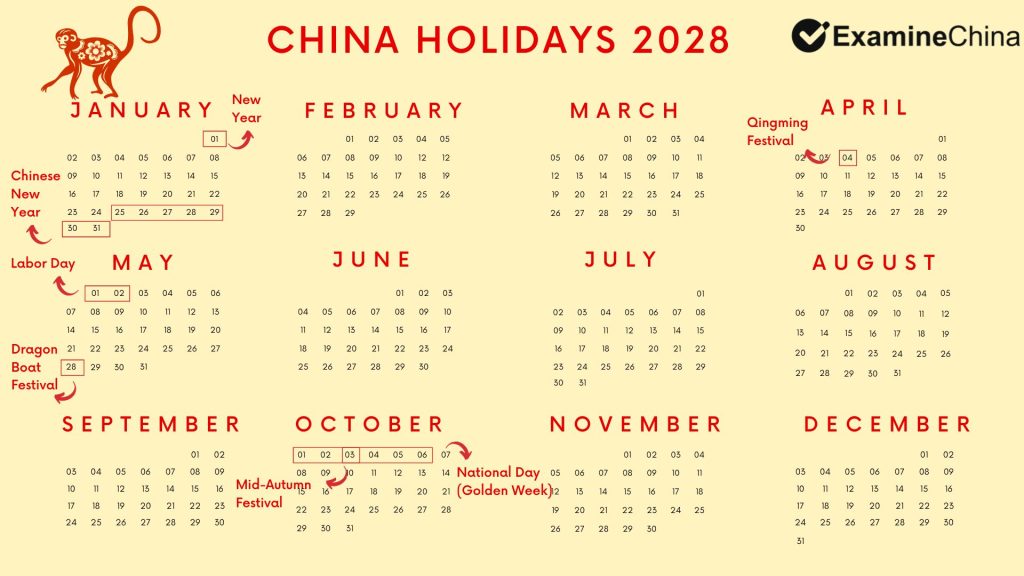
China holiday calendar 2028
| Holiday | Date in 2028 | Expected days off (to be confirmed) |
|---|---|---|
| New Year’s Day | January 1 (Saturday) | about 1 to 3 days |
| Spring Festival (Chinese New Year) | January 26 (Wednesday), Eve on January 25 | about 8 days, late January into February |
| Qingming (Tomb Sweeping Day) | April 4 (Tuesday) | about 3 days |
| Labor Day | May 1 (Monday) | about 5 days |
| Dragon Boat Festival | May 28 (Sunday) | about 3 days |
| Mid-Autumn Festival and National Day (Golden Week) | National Day October 1 (Sunday), Mid-Autumn October 3 (Tuesday) | about 8 days, October 1 to 8 |
One thing worth knowing: as of 2025, China increased its statutory holiday allowance from 11 to 13 days. Spring Festival and Labor Day each gained a day, so the breaks now run longer than importers who remember the pre-reform schedule might expect. In practice, Spring Festival is usually around 8 days off, and the October Golden Week runs 7 to 8 days.
The major 2028 holidays and how they hit orders from China
New Year’s Day (January 1)
The first day of the Gregorian year is a public holiday in China. The break is short and doesn’t move deadlines much on its own, but early January can still feel sluggish as companies get back up to speed after the turn of the year.
Spring Festival, or Chinese New Year (春节)
This is the biggest and most important holiday in China, set by the lunar calendar. In 2028, it falls on January 26 (with New Year’s Eve on January 25) and opens the Year of the Monkey. Expect roughly 8 days off around the turn of the month, though the real slowdown lasts longer. Many workers travel back to their hometowns and extend their time off, so factories can take another 1 to 2 weeks to rebuild full capacity. It’s the single most demanding stretch on an importer’s calendar.
It’s also the riskiest time to start with a new supplier. If you’re about to wire a deposit to a company you don’t yet know right before Spring Festival, go in with your eyes open. An eight-day silence is plenty of time for a bad actor to disappear with your money. A Credit Report checks the company in 48 hours, before you send a cent.
Qingming, Tomb Sweeping Day (清明节)
Qingming falls on April 4, 2028, and centers on visiting graves and honoring ancestors. The break is short, usually about 3 days, but people often take extra days around it, so expect limited contact with partners and the odd local shipping delay.
Labor Day (May 1)
International Labor Day lands on May 1. Since the 2025 reform, it’s no longer a single day but usually around 5 days off. For importers, that means a multi-day production pause and reduced port operations, on top of one of China’s busier domestic travel windows, which adds pressure to transport.
Dragon Boat Festival (端午节)
The Dragon Boat Festival, known for its colorful boat races and zongzi rice dumplings, falls on May 28 in 2028. The break is shorter, about 3 days, but even that can push production or shipping dates if your order runs right into it.
Golden Week and the Mid-Autumn Festival
National Day starts on October 1 and normally brings 7 days off. In 2028, it overlaps with the Mid-Autumn Festival (October 3), so the break will most likely be merged into a single longer block of about 8 days. After Spring Festival, this is the second stretch when a large share of offices, factories, and businesses simply aren’t working, and ports run at reduced capacity.
How Chinese holidays affect importers
During periods like Spring Festival or Golden Week, many factories shut down production entirely. In practice, that means:
- orders placed too late before the holidays may not be finished on time,
- workers return gradually, so it can take 1 to 2 weeks to reach full capacity again,
- ports often run at limited capacity and loading slots get scarce,
- freight rates can climb during the pre-holiday peak,
- during the holidays, many staff simply don’t answer emails or inquiries.
Booking shipments at the last minute before a holiday can turn into delays measured in weeks. Larger orders are worth placing several weeks ahead, and freight and containers are worth reserving before the pre-holiday rush kicks in.
How to prepare for the 2028 Chinese holidays
A few habits meaningfully reduce the risk of a stall:
- place larger orders several weeks before the break,
- reserve containers and freight early, since loading slots vanish fast,
- build a time buffer for delays instead of banking on the perfect scenario,
- close the loop with suppliers early, before offices empty out for a week.
One of the most important steps is inspecting your goods before the factory closes for the holiday. If defects surface after the plant shuts down, fixes wait until the crew returns, which can mean weeks. Quality control in China catches problems while workers are still on-site and before you release the final payment. It’s also worth putting the terms in writing with a commercial contract, and for a large order, checking the factory’s real capacity with a factory inspection.
Importers who plan ahead come out ahead. They avoid costly delays and keep their supply chain moving even through China’s biggest holidays.